

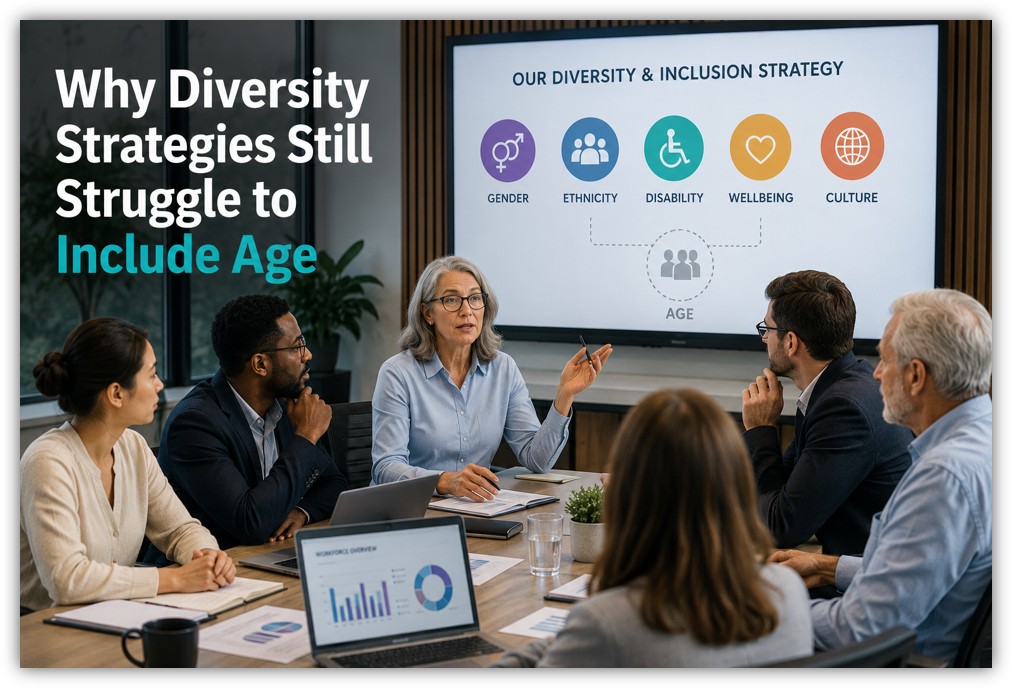
Over the past decade, diversity, equity and inclusion (DE&I) has become a strategic priority for many organisations. Employers have invested in programmes, policies and initiatives designed to create more inclusive workplaces and improve representation across a range of characteristics. Yet despite this progress, one dimension of diversity continues to receive significantly less attention than others: age.
Recent academic research has highlighted a phenomenon described as “ambivalent inclusion”, where older workers may be formally included within diversity initiatives but continue to experience exclusion through workplace attitudes, assumptions and organisational practices.
The findings raise important questions about whether many organisations have truly integrated age into their inclusion strategies. For employers seeking to build genuinely inclusive workplaces, the message is clear, recognising age diversity is not the same as achieving age inclusion.
Progress Has Been Made – But Age Often Remains Invisible
Most organisations now recognise the value of diversity, many have established programmes focused on gender equality, ethnicity, disability, LGBTQ+ inclusion and other important dimensions of workplace diversity. These efforts have helped drive meaningful change.
However, age is frequently absent from organisational DE&I frameworks, reporting structures and inclusion strategies. In some organisations, age is mentioned only briefly. In others, it is grouped alongside broader wellbeing or workforce planning discussions rather than treated as an inclusion issue in its own right. This can create a significant blind spot.
Unlike many other diversity characteristics, age affects everyone. Every employee has an age, and every employee’s relationship with age changes throughout their working life, yet age remains one of the least discussed dimensions of workplace inclusion.
The Challenge of Stereotypes
One reason age is often overlooked is that age-related stereotypes remain deeply embedded within organisational culture.
Older workers may be perceived as less adaptable, less innovative or less interested in career progression. Younger workers may be viewed as inexperienced, entitled or lacking commitment.
These assumptions can influence recruitment decisions, promotion opportunities, access to development and perceptions of performance. Importantly, such stereotypes often operate unconsciously.
An organisation may genuinely believe it supports employees of all ages while simultaneously maintaining practices that disadvantage certain age groups. This is where the concept of ambivalent inclusion becomes particularly relevant. Employees may feel welcomed in some respects while continuing to encounter subtle barriers linked to age.
Inclusion Requires More Than Representation
Many organisations measure diversity through workforce demographics. While representation matters, it tells only part of the story…A workforce can be age-diverse without being age-inclusive.
Employees from different age groups may still experience unequal access to opportunities, inconsistent development support or assumptions about their future potential. True inclusion requires organisations to examine how people experience work, not simply whether they are present within the workforce.
Questions leaders should consider include:
-
Are employees of all ages represented in leadership pipelines?
-
Do learning and development opportunities reach all age groups?
-
Are recruitment processes free from age bias?
-
Do organisational policies support people at different life and career stages?
-
Is age discussed openly as part of inclusion conversations?
These questions move the discussion beyond representation towards meaningful inclusion.
Why Age Matters More Than Ever
The case for age inclusion is becoming increasingly difficult to ignore. Across many countries, populations are ageing, working lives are extending, and career paths are becoming more varied and less linear.
At the same time, organisations are managing increasingly multigenerational workforces, with up to five generations potentially working alongside one another. These demographic shifts are reshaping the workplace.
Organisations that fail to address age inclusion risk overlooking valuable talent, limiting workforce participation and undermining employee engagement. Conversely, employers that embrace age diversity can benefit from broader perspectives, stronger knowledge sharing and improved organisational resilience. Age inclusion is not simply a social issue. It is increasingly becoming a business issue.
Moving from Awareness to Action
Many organisations already recognise that age matters, so the next challenge is translating awareness into practical action…this requires a more deliberate approach.
Age should be embedded within broader DE&I strategies rather than treated as a separate or occasional consideration. Leaders should seek to understand the experiences of employees at different life stages and ensure that age-related data informs workforce planning decisions.
Organisations should also review policies, recruitment practices, learning opportunities and progression pathways through an age-inclusive lens. Most importantly, age needs to become part of everyday inclusion conversations. Employees cannot challenge assumptions that remain invisible.
Conclusion
The research on ambivalent inclusion highlights an uncomfortable reality…many organisations have made significant progress on diversity and inclusion while leaving age at the margins of the conversation. Yet age affects every employee, every team and every organisation.
As workplaces become increasingly multigenerational, age inclusion can no longer be viewed as an optional addition to DE&I. It must become an integral part of how organisations think about talent, culture and inclusion.
The challenge for employers is not whether age should be included in their diversity strategy, the challenge is ensuring that age inclusion becomes visible, measurable and actionable. Only then can organisations move from awareness to genuine inclusion.
References
Burns, J., Fasbender, U. and Gerpott, F.H. (2026) ‘Older workers’ experiences of inclusion and exclusion in organisations: Exploring ambivalent inclusion’, Work, Employment and Society.
Centre for Ageing Better (2025) Ageism and the Workplace. Available at: https://ageing-better.org.uk
The Age Diversity Forum (2026) Age Inclusion Benchmark Diagnostic Framework.