

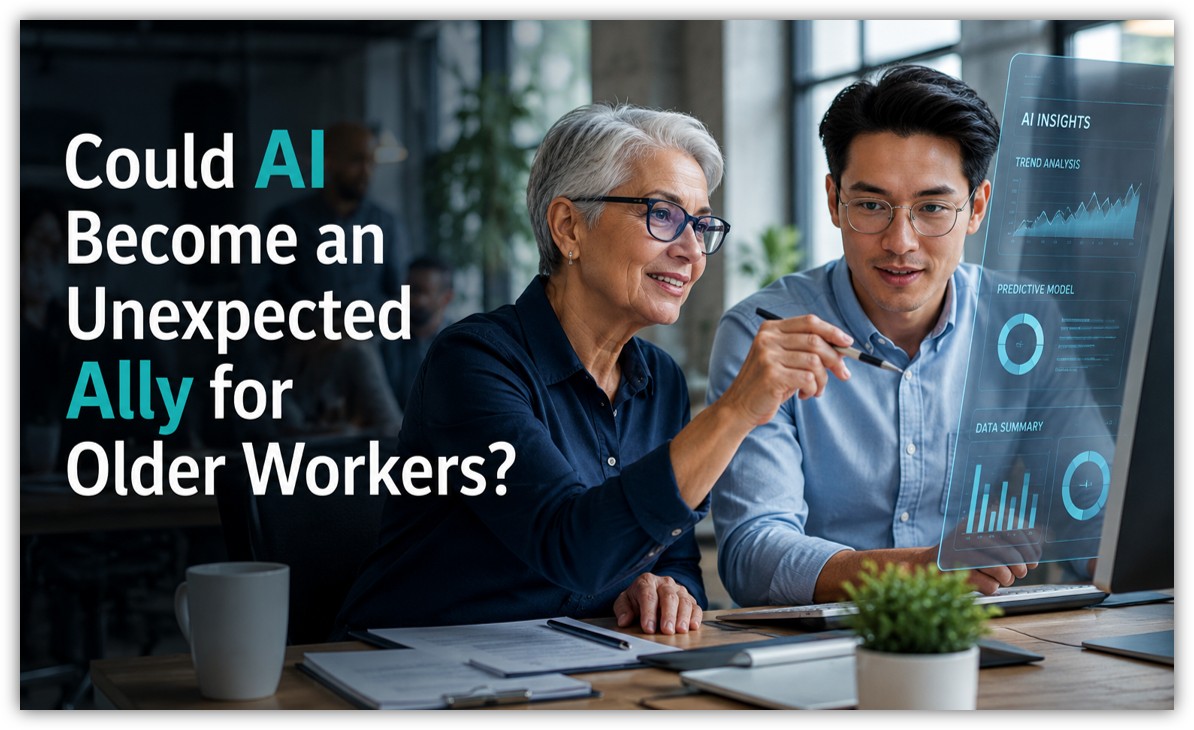
Artificial intelligence (AI) is often portrayed as a force that will transform work, disrupt careers and reshape organisations. Much of the public discussion has focused on automation, job displacement and the need for new digital skills. Yet a growing body of evidence suggests a more nuanced reality may be emerging.
Recent reporting on a global CEO survey found that many business leaders expect AI to reduce demand for some entry-level roles while increasing the value of experienced employees who can provide judgement, context and decision-making. This challenges a common assumption that technological change inevitably disadvantages older workers.
For organisations seeking to build age-inclusive workplaces, this development raises an important question. Could AI become an unexpected ally for older workers?
The Traditional Narrative
Historically, discussions about technology and age have often been framed through a deficit lens. Older workers have frequently been portrayed as less adaptable, less digitally capable or more resistant to change. Such assumptions have contributed to persistent age-related stereotypes in recruitment, training and career development. The reality is far more complex.
Research consistently shows that digital capability is influenced by factors such as opportunity, training, exposure and organisational support rather than age alone. While some individuals may require additional support to develop new skills, this applies across all age groups.
At the same time, organisations increasingly recognise that experience brings valuable capabilities that are difficult to automate. These include critical thinking, stakeholder management, ethical judgement, relationship building and strategic decision-making.
As AI becomes more prevalent, these human capabilities may become even more important.
Experience as a Competitive Advantage
Many AI systems excel at processing information, identifying patterns and generating content. However, they do not possess lived experience, organisational memory or contextual understanding.
An experienced employee can often identify risks, opportunities and unintended consequences that may not be apparent from data alone. They can interpret information through the lens of industry knowledge, customer relationships and previous organisational experiences.
This combination of technological capability and human judgement may prove to be one of the most valuable assets available to organisations. Rather than replacing experienced workers, AI may enhance their ability to contribute. Routine administrative tasks can be automated, allowing employees to focus on higher-value activities such as mentoring, problem-solving and strategic planning.
In this context, experience becomes more valuable, not less.
The Rise of the AI-Enabled Multi-generational Workforce
The most successful organisations are unlikely to be those that choose between technology and people. Instead, they will find ways to combine the strengths of both. This is where age diversity becomes increasingly relevant.
Younger employees may bring confidence with emerging technologies, fresh perspectives and new approaches to communication. More experienced colleagues may contribute industry expertise, organisational insight and broader professional networks. AI has the potential to accelerate collaboration between generations rather than create division between them.
Organisations that encourage ideas such as knowledge sharing, reverse mentoring and multigenerational teamwork, are likely to be better positioned to realise the full benefits of AI adoption.
The challenge is not managing different generations…the challenge is creating environments where different generations can learn from one another.
Rethinking Workforce Development
As AI reshapes work, employers will need to reconsider how they invest in learning and development. Too often, training budgets are concentrated on early-career talent while assumptions persist that older employees are approaching the end of their working lives. Such thinking is increasingly out of step with demographic realities.
People are working longer, careers are becoming less linear, so skills need continuous renewal throughout working life. Organisations that restrict development opportunities based on age risk undermining their own competitiveness.
An age-inclusive approach to workforce development ensures that employees of all ages have access to learning, digital upskilling and career progression opportunities. This not only supports inclusion but also helps organisations maximise the return on their investment in technology.
Moving Beyond Stereotypes
Perhaps the most important lesson from the emerging AI debate is that it challenges some of the stereotypes that have shaped attitudes towards age in the workplace. The assumption that technological change automatically favours younger workers may no longer hold true. As AI takes on more routine tasks, the qualities that distinguish human contribution are likely to become increasingly important.
These qualities are not confined to any single generation. Innovation, adaptability, curiosity and learning can be found at every age. Equally, experience, judgement and wisdom remain valuable organisational assets. Employers that recognise this reality will be better positioned to attract, retain and develop talent across the age spectrum.
Conclusion
AI is undoubtedly transforming the world of work, but its impact on age inclusion may be more positive than many anticipated. Rather than rendering experience obsolete, AI may increase demand for the very qualities that experienced workers bring to organisations. In doing so, it offers an opportunity to challenge outdated assumptions about age and capability.
The future of work is unlikely to belong to one generation. It will belong to organisations that successfully combine technology, experience and diverse perspectives.
For employers, the message is clear, age inclusion is not separate from the AI conversation. it is becoming an essential part of it.
References
Bloomberg (2026) AI Poised to Tilt Job-Market Leverage Toward Older Workers. Available at: https://www.bloomberg.com/news/articles/2026-05-16/ai-poised-to-tilt-job-market-leverage-toward-older-workers
Fortune (2026) CEOs Say AI Could Increase Demand for Experienced Talent. Available at: https://fortune.com