Over the past decade, organisations have made significant investments in diversity, equity and inclusion. Many now collect data, monitor progress and report against objectives relating to gender, ethnicity, disability and other important dimensions of workplace diversity.

Yet when it comes to age inclusion, many organisations face a fundamental challenge. They know age matters…they recognise the value of attracting, retaining and developing talent across all age groups…they understand that demographic change, longer working lives and multigenerational workforces are reshaping the world of work…BUT…they often struggle to answer a simple question – How age-inclusive are we today?

Without a clear answer, it becomes difficult to identify priorities, measure progress or demonstrate impact..this is why measurement matters.

The Challenge of Invisible Progress

Many organisations have taken positive steps towards age inclusion. They may have introduced flexible working arrangements, reviewed recruitment practices, launched employee networks or delivered awareness training. These initiatives can be valuable.

However, without a structured framework, it is often difficult to understand whether these activities are creating meaningful organisational change. Leaders may assume progress is being made because individual initiatives exist, employees may have very different experiences…inclusion can feel subjective. Measurement provides a way to move beyond assumptions and develop a clearer understanding of organisational reality.

Why Age Has Been Difficult to Measure

Part of the challenge is that age inclusion is often viewed differently from other aspects of diversity. Age affects every employee, it changes throughout an individual’s life and career, and it intersects with many other aspects of identity and experience. As a result, organisations sometimes treat age as a demographic issue rather than an inclusion issue.

Others focus solely on workforce age profiles without examining culture, leadership, development opportunities or organisational practices. Yet age inclusion cannot be understood through demographics alone.

An organisation may have employees from a wide range of age groups and still experience age bias, unequal opportunities or age-related barriers. True age inclusion requires a broader perspective.

Moving Beyond Numbers

Effective measurement combines quantitative and qualitative insight. It is important to understand workforce demographics, but organisations must also explore how age influences recruitment, development, progression, leadership, culture and employee experience.

Questions worth considering include:

  • Is age recognised within organisational inclusion strategies?

  • Are recruitment processes free from age-related assumptions?

  • Do employees of all ages have access to development opportunities?

  • Is age diversity represented within leadership pipelines?

  • Do employees feel respected and valued regardless of age?

  • Are managers equipped to lead multigenerational teams?

The answers to these questions often reveal strengths, gaps and opportunities that may otherwise remain hidden.

Introducing the Age Inclusion Benchmark

At The Age Diversity Forum, we have spent more than a decade working with organisations seeking to improve age inclusion. Throughout that time, one challenge has consistently emerged…employers want practical ways to assess where they are today and identify where they need to focus next.

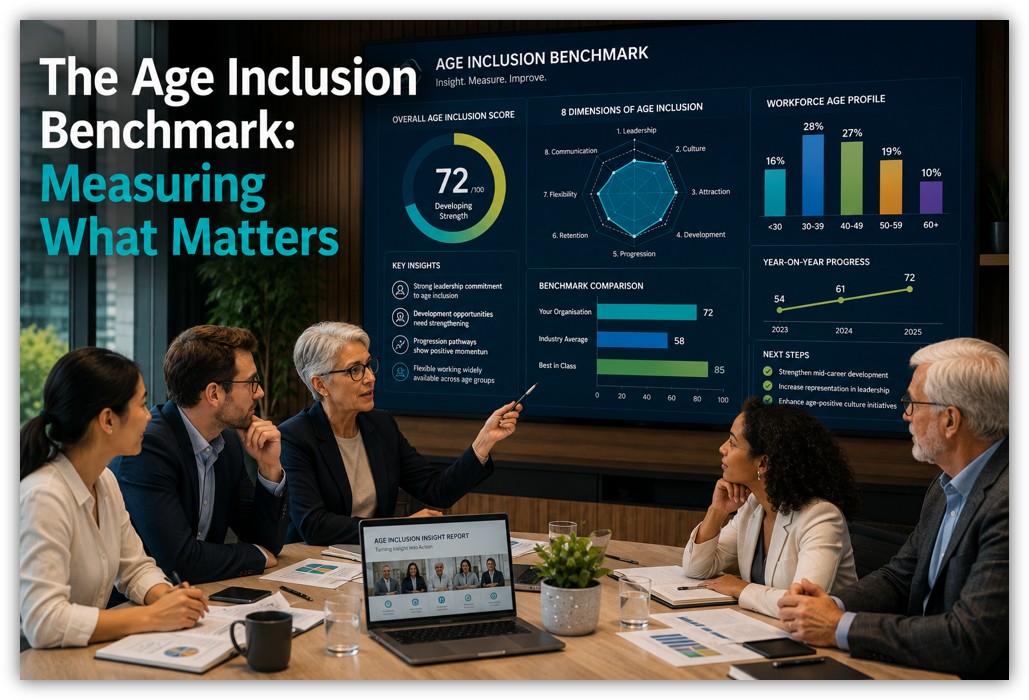
This led to the development of the Age Inclusion Benchmark Diagnostic. The Benchmark has been designed as a structured assessment framework that helps organisations evaluate age inclusion across eight key dimensions.

Rather than focusing solely on policies or demographics, it explores the broader organisational environment, examining the systems, behaviours and practices that shape employee experiences. The objective is not to generate a score for its own sake…the objective is to provide meaningful insight.

From Assessment to Action

One of the most important benefits of benchmarking is that it creates a starting point for action.

Organisations often know that age inclusion matters but are unsure where to begin. Others have already taken steps and want to understand whether their efforts are having an impact, a structured benchmark provides clarity.

It helps organisations identify strengths that can be built upon, as well as areas where additional attention may be required. Most importantly, it creates a foundation for continuous improvement. Age inclusion is not a one-off initiative. It is an ongoing journey that evolves alongside workforce demographics, organisational priorities and societal change.

Building Accountability

Measurement also plays an important role in accountability. When organisations can establish a baseline, they are better positioned to track progress over time, evaluate interventions and demonstrate commitment to inclusion.

This is particularly important as age becomes an increasingly strategic workforce issue. Boards, executive teams and HR leaders are under growing pressure to understand workforce risks, talent shortages and changing employee expectations. Age inclusion forms part of this conversation, and reliable measurement helps organisations move from aspiration to evidence.

Conclusion

Age inclusion is becoming an increasingly important consideration for organisations across every sector, yet progress can be difficult to achieve when organisations lack a clear understanding of their current position.

Measurement provides the foundation for meaningful action. By establishing a baseline, identifying priorities and tracking progress over time, organisations can move beyond good intentions and create more inclusive workplaces for employees of all ages.

The challenge is not simply recognising that age matters…the challenge is measuring what matters and acting upon what we learn.

About the Age Inclusion Benchmark Diagnostic

The Age Inclusion Benchmark Diagnostic is The Age Diversity Forum’s evidence-based assessment framework designed to help organisations evaluate age inclusion across eight key dimensions. Participating organisations receive a comprehensive Insight Report that highlights strengths, opportunities and priorities for future action.

Contact John to find out more: [email protected]