

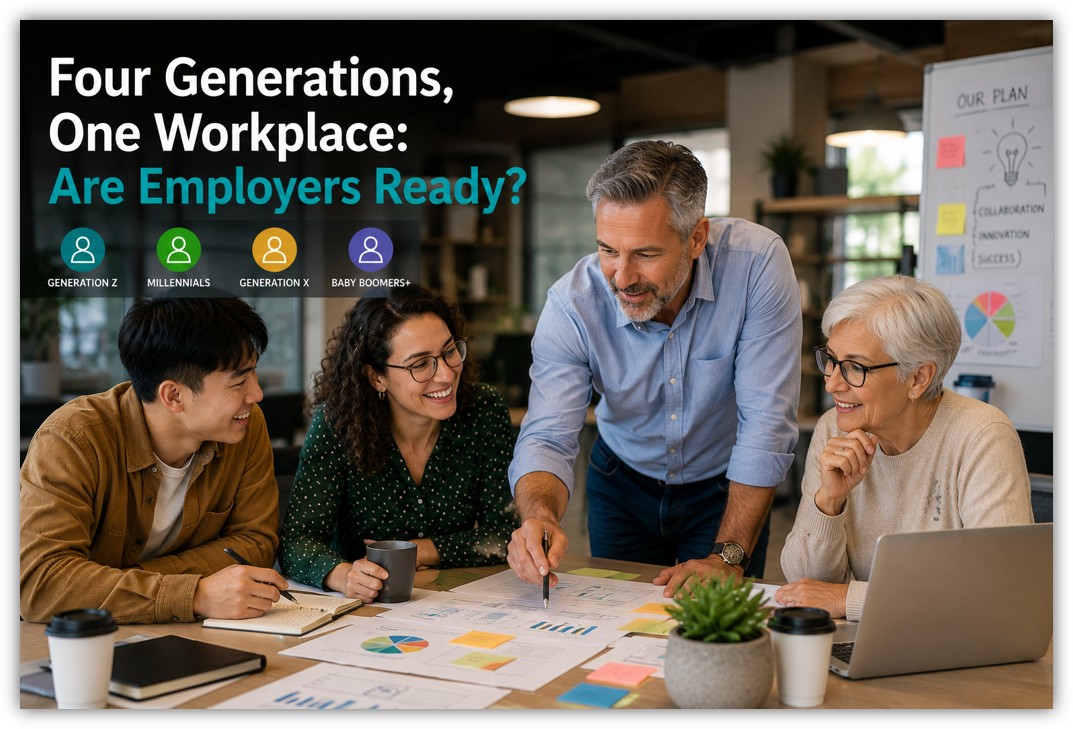
For much of modern employment history, workplaces were relatively age-homogeneous. Employees often followed similar career paths, retired at broadly similar ages and worked within clearly defined organisational structures. Today, that picture has changed dramatically.
Many organisations now employ four generations simultaneously and, in some cases, five generations are beginning to emerge within the workforce. Employees may range from those just entering employment to colleagues with decades of experience who continue to work beyond traditional retirement ages.
This demographic shift is one of the most significant workplace transformations of our time. Yet while organisations have invested considerable effort in understanding cultural diversity, gender diversity and other aspects of inclusion, many are only beginning to recognise the opportunities and challenges associated with age diversity. The question is no longer whether organisations will become multigenerational. The question is whether they are prepared to make the most of it.
A New Workforce Reality
Longer life expectancy, changing retirement patterns and evolving career expectations are reshaping labour markets around the world. Many people are choosing to work later in life, whether for financial reasons, personal fulfilment or the desire to remain professionally active.
At the same time, younger generations are entering organisations with different experiences, expectations and approaches to work. As a result, organisations increasingly find themselves bringing together people from multiple generations with different perspectives, communication styles and career experiences. This reality is sometimes presented as a challenge…in practice, it represents a significant opportunity.
The Strength of Age Diversity
Research consistently shows that diverse teams can outperform less diverse groups when managed effectively, Age diversity is no exception. Employees at different stages of life often bring complementary strengths.
Early-career employees may contribute fresh perspectives, digital confidence and new ways of approaching problems. Mid-career professionals frequently provide operational expertise and leadership capability. More experienced employees often offer strategic insight, organisational memory and deep industry knowledge.
These strengths are not mutually exclusive, nor are they confined to specific age groups. However, they illustrate how different experiences can enhance collective performance. When organisations create opportunities for these perspectives to interact, the benefits can be substantial.
Innovation improves when different viewpoints are considered. Decision-making becomes more robust. Knowledge flows more effectively across teams…Age diversity can strengthen organisational resilience.
Moving Beyond Generational Stereotypes
Despite these benefits, many organisations continue to rely on simplistic assumptions about generations. Popular narratives often suggest that one generation values flexibility while another values loyalty. One generation is portrayed as technologically confident while another is assumed to struggle with change…such stereotypes can be unhelpful.
Individuals are shaped by a wide range of factors, including education, career history, personality, culture and life experience, demonstrating that Age is only one part of a much more complex picture.
The risk of generational labelling is that it encourages organisations to focus on perceived differences rather than shared goals and complementary strengths. Successful employers recognise that people are individuals first and members of generations second.
The Importance of Knowledge Exchange
One of the greatest opportunities within multigenerational workplaces is knowledge sharing.
For decades, organisations have relied upon informal processes through which employees learn from one another. However, demographic change and evolving working patterns have increased the importance of making these processes more deliberate.
Experienced employees possess valuable organisational knowledge that may take years to develop. Younger employees often bring insights into emerging technologies, changing customer expectations and new ways of working. Both forms of knowledge matter.
Forward-thinking organisations are increasingly investing in mentoring, reverse mentoring and collaborative learning programmes that encourage knowledge exchange across age groups.
These initiatives help break down assumptions while creating stronger organisational capability.
Building an Age-Inclusive Culture
The benefits of age diversity do not emerge automatically. Organisations must create environments in which employees of all ages feel valued, respected and able to contribute.
This requires leaders to examine recruitment practices, development opportunities, promotion pathways and workplace culture through an age-inclusive lens.
Questions employers should consider include:
-
Are opportunities available to employees at every stage of their career?
-
Do learning and development programmes reach all age groups?
-
Are assumptions about age influencing talent decisions?
-
Is knowledge sharing encouraged across generations?
-
Do employees feel respected regardless of age?
An age-inclusive culture benefits everyone, it enables organisations to attract talent from wider pools, retain valuable experience and build stronger relationships between employees.
A Strategic Advantage
As labour markets continue to evolve, age diversity is increasingly becoming a strategic issue rather than simply a workforce characteristic. Organisations face ongoing skills shortages, changing customer demographics and increasing pressure to innovate. Meeting these challenges requires access to the widest possible range of talent, perspectives and experiences. A multi-generational workforce offers exactly that.
The most successful organisations of the future are unlikely to be those that focus on one generation at the expense of another. Instead, they will be those that create environments where people of different ages can contribute, learn and succeed together.
Conclusion
The rise of the multi-generational workforce is one of the defining workplace trends of the twenty-first century. For employers, this presents both a challenge and an opportunity.
The challenge is moving beyond stereotypes and outdated assumptions…the opportunity is creating workplaces where different experiences, perspectives and skills combine to strengthen organisational performance.
Age diversity is not simply a demographic reality, when supported by an inclusive culture, it becomes a strategic advantage. The organisations that recognise this today will be better prepared for the workforce of tomorrow.
References
Ciphr and ProAge (2026) Multigenerational Working Survey Launch.
Altum Nova (2026) The Impact of Age-Diverse Teams on Organisational Performance: A Systematic Review.
The Age Diversity Forum (2026) Age Diversity and Multigenerational Working Resources.